Best Alternative to DocsAutomator for Airtable (2026 Comparison)
TypeFlow and DocsAutomator both include e-signatures at no extra cost. TypeFlow includes unlimited standard e-signatures (SES) on every paid plan, with no per-document signing charge; DocsAutomator announced in October 2026 that e-signing and acceptance are included in every plan, where a signed document counts as one document against the plan allowance. Signing is no longer what separates the two - compare them on document allowance per tier, on template options, and on how far each one reaches into Airtable.
TypeFlow vs DocsAutomator: Quick Comparison
| TypeFlow | DocsAutomator | Documint | |
|---|---|---|---|
| Entry plan | $29/mo (200 docs) | $29/mo (100 docs) | $49/mo (200 docs) |
| Mid plan | $49/mo (1,000 docs) | $79/mo (1,000 docs) | $149/mo (1,000 docs) |
| Top plan | $199/mo (unlimited) | $199/mo (5,000 docs) | $299/mo (5,000 docs) |
| E-signature | Unlimited on all plans | Included on all plans (counts as 1 doc) | 5 envelopes/mo |
| Automations | Unlimited on all plans | 5 / 20 / unlimited | All plans |
| Template builder | Google Docs + HTML/CSS template builder | Google Docs | Drag-and-drop editor |
| Linked records | Native access, no rollups | Requires rollups/lookups | Requires rollups/lookups |
| View-to-PDF export | Yes | No | No |
TypeFlow signatures do not draw down the document allowance: a signed document is sent for signature, not counted twice. On DocsAutomator a signed or accepted document counts as one document against the plan, however many recipients it has.
E-Signature: TypeFlow vs DocsAutomator
Both include e-signatures at no extra cost. The difference is what a signature costs you in plan allowance.
On DocsAutomator, a signed or accepted document counts as one document against your monthly allowance, however many recipients it has. On TypeFlow, sending for signature is not a second document: the generated document is counted once, and the signature, reminders, Certificate of Completion and audit trail ride along with it.
| TypeFlow | DocsAutomator | |
|---|---|---|
| Per-signature fee | None | None |
| Counts against document allowance | No | Yes, 1 per signed document |
| Signers per document | Unlimited | Unlimited |
| Certificate of Completion | Yes | Yes |
| Signing page on your own domain | Enterprise | - |
Pricing and signing terms checked October 12, 2026. "Standard e-signature" refers to TypeFlow SES. Verify current pricing on DocsAutomator's pricing page and TypeFlow's pricing page.
TypeFlow and DocsAutomator both use Google Docs for template building, integrate natively with Airtable, and include e-signatures at no extra cost. They differ on how far each one goes into Airtable: TypeFlow reads linked records directly without rollups or lookups, adds an HTML/CSS template builder and fillable PDF forms alongside Google Docs, and exports an Airtable view straight to PDF. DocsAutomator reaches wider instead, with Zapier, Make, Google Sheets, ClickUp and Glide.
Key Takeaways
- E-Signature: both include e-signatures at no extra cost. On DocsAutomator a signed document counts as one document against your allowance; on TypeFlow it does not count a second time. TypeFlow adds OTP verification, reminders, and signing pages on your own domain on Enterprise.
- Pricing: Both start at $29/mo - but total cost diverges fast once you add e-signatures. DocsAutomator's Business plan is $79/mo vs TypeFlow Pro at $49/mo for the same 1,000 docs.
- Templates: Both use Google Docs. TypeFlow also offers an HTML/CSS template builder and supports loop tables - DocsAutomator does not.
- Integrations: DocsAutomator connects to more platforms (Zapier, Make, Google Sheets, ClickUp, Glide). TypeFlow specializes in Airtable + Softr with deeper native features.
- Airtable-specific: TypeFlow supports linked record field access, view-to-PDF export, and scheduled reports. DocsAutomator has broader integrations but shallower Airtable functionality.
- Invoicing: If invoicing is your primary use case, see our Best Invoicing Tools for Airtable in 2026 guide for the full landscape.
What Is Document Generation Software for Airtable?
Document generation software takes data from your Airtable base and merges it into templates to create finished PDFs - invoices, contracts, certificates, labels, reports, and more. Instead of copy-pasting data from Airtable into Word or Google Docs, you set up the template once and documents generate automatically.
The best tools for Airtable connect natively (no Zapier required), support linked records and line items, and include e-signatures so the entire workflow stays inside Airtable. Common setups include:
- Button-triggered generation - click a button on an Airtable record to generate the PDF
- Automation-triggered generation - a status change or form submission generates the document automatically
- Scheduled generation - reports generate on a recurring schedule and send via email
For a full guide on the category, see our Airtable document generation guide.
Why Airtable's Native Tools Fall Short
Airtable's Page Designer was the built-in option for document generation, but it has been deprecated and cannot handle what most teams need:
- Single-page only. No multi-page invoices, contracts, or reports.
- No e-signatures. You need a separate tool for any signed document.
- No automation. Documents don't generate automatically on triggers.
- No linked record line items. Can't pull repeating data from related tables into a document.
- No batch generation. One document at a time - no view exports or scheduled reports.
For anything beyond a basic single-page layout, you need a dedicated tool. For more detail, see our Alternative to Page Designer guide.
TypeFlow vs DocsAutomator: Feature Comparison
TypeFlow is the better choice if you work exclusively in Airtable and need advanced document features like nested line items and loop tables. DocsAutomator is better if you need to connect multiple platforms like Zapier, Make, or Google Sheets.
Both tools use Google Docs for template building, making them accessible to non-technical users. TypeFlow also offers an HTML/CSS template builder as an alternative.
How TypeFlow Works
- Connect your Airtable base - select the table and fields you want to use in your documents.
- Build your template - use Google Docs (insert
{{variables}}) or the HTML/CSS template builder with pre-built blocks. - Map your fields - connect Airtable fields to template variables, including linked records and line items.
- Generate - click a button, trigger via automation, or schedule reports. The PDF generates and saves back to your Airtable record.
How TypeFlow works
Then, it's easy to map the data between the Google Docs variables and the Airtable fields.
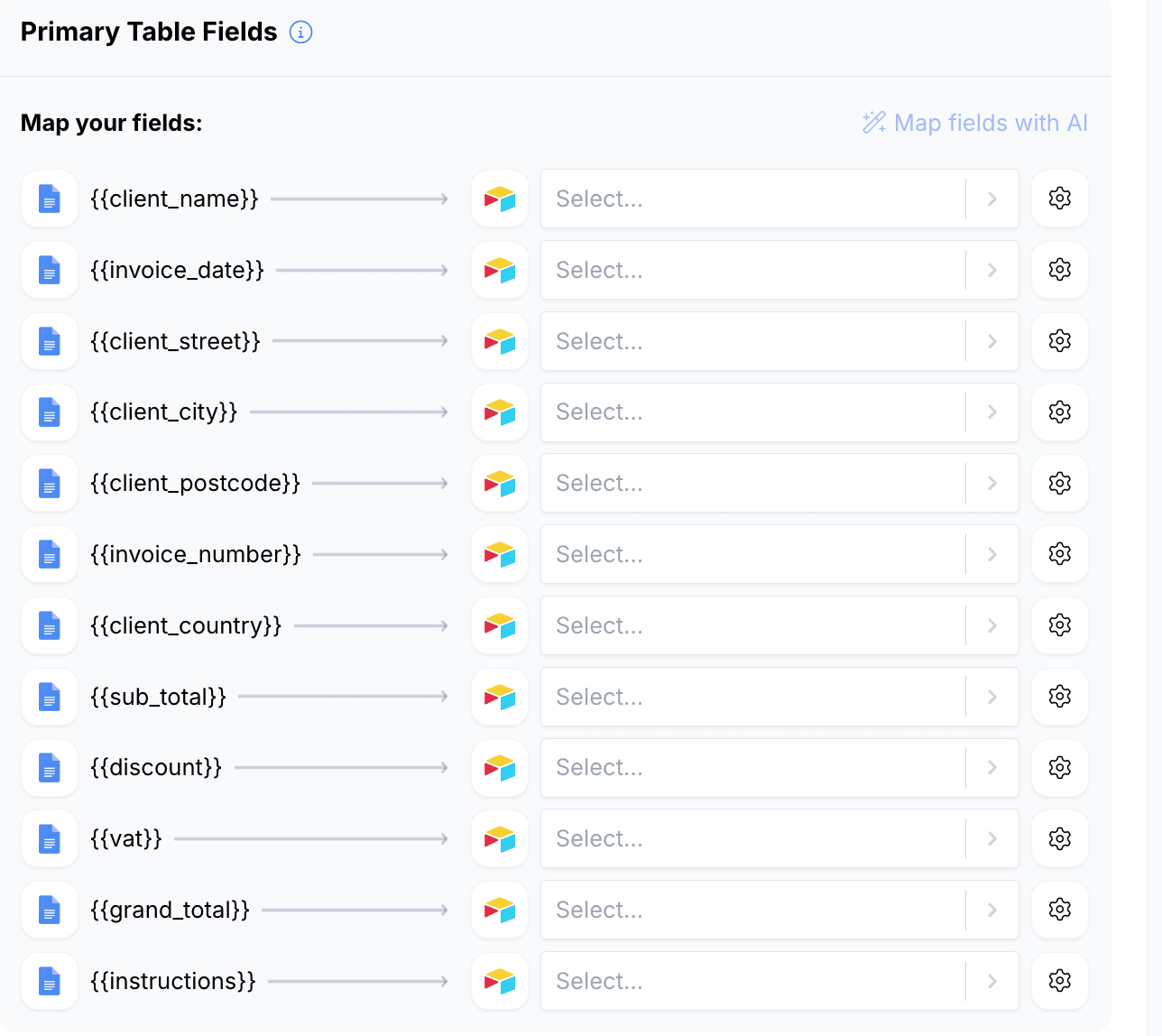
DocsAutomator offers robust PDF generation features:
- Line items and dynamic images: Insert repeating data and images from your records
- Conditional styling: Fine-tune PDF output based on field values
- Google Doc export: Save documents for manual editing afterward
- Native email sending: Send documents directly without relying on Airtable Automation
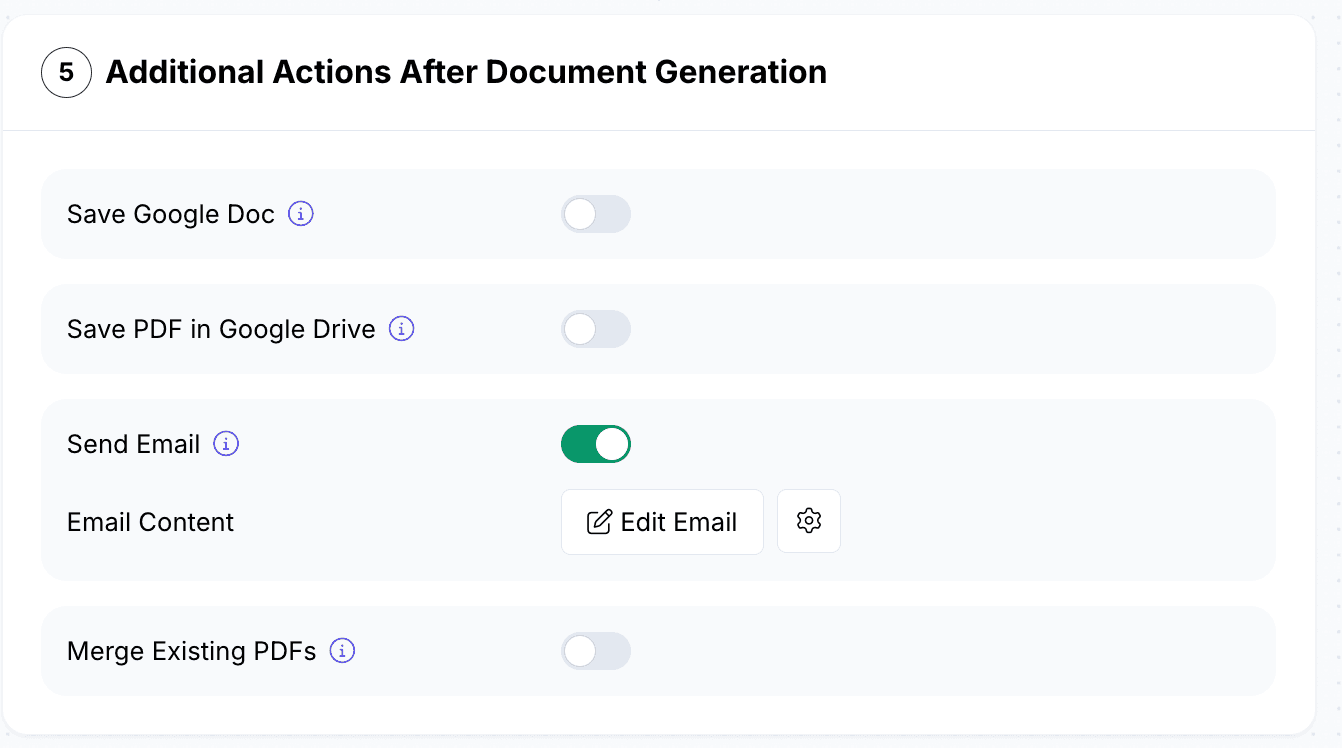
TypeFlow works similarly - you build templates in Google Docs. Here's what you can do:
- Field mapping: Connect Airtable fields to Google Docs variables
- Automated generation: Generate PDFs via automation scripts on autopilot
- Conditional logic: Hide or display sections based on field criteria
- Google Doc export: Save as editable Google Docs for fine-tuning
The HTML/CSS template builder expands your options further. The main difference between the two tools comes down to integrations and e-signature pricing.
TypeFlow vs DocsAutomator: Integrations
DocsAutomator integrates with:
If you use multiple platforms, DocsAutomator offers flexibility. TypeFlow integrates with Airtable and Softr only - but goes deeper on Airtable-specific functionality at a lower price.
TypeFlow's Airtable-specific features that DocsAutomator lacks:
- Linked record access - pull data from related tables without creating rollup or lookup fields
- View-to-PDF export - export entire Airtable views as formatted PDF reports
- Scheduled reports - generate and send reports on a recurring schedule
- Loop tables - repeat rows of data from linked records in your document
What Signing Actually Costs on Each
Neither tool charges per signature. DocsAutomator removed its per-document signing fee in October 2026; before that it was $0.50 per document sent for signature.
What remains is how a signature draws down your plan. On DocsAutomator a signed or accepted document counts as one document in the allowance, the same as any other. On TypeFlow it does not count a second time - the document is counted when it is generated, and sending it for signature is part of the same operation.
That matters once signing is routine rather than occasional: a team on a 1,000-document plan that sends 400 of them for signature is using 1,400 units of allowance on one tool and 1,000 on the other.
Both include Certificates of Completion, full audit trail and unlimited signers. TypeFlow adds OTP verification, reminders, delivery through your own Gmail, and signing pages on your own domain with your branding on Enterprise.
TypeFlow vs DocsAutomator: Pricing Breakdown
TypeFlow starts at $29/month (Starter) for 200 documents, with unlimited e-signatures included on all plans. Pro is $49/month for 1,000 docs, Enterprise is $199/month for unlimited. Start free with 20 documents, no credit card required. Annual billing saves 20%.
DocsAutomator pricing (as of September 2026): Professional at $29/month for 100 documents and 5 automations, Business at $79/month for 1,000 documents and 20 automations, Scale at $199/month for 5,000 documents and unlimited automations. E-signing and acceptance are included in every plan at no extra cost, with a signed document counting as one document against the allowance.
At the same price point the difference is allowance and automations: TypeFlow Pro gives 1,000 documents with unlimited automations, where DocsAutomator Business gives 1,000 documents and 20 automations. Signed documents draw down that allowance on DocsAutomator and not on TypeFlow, so the gap widens with how much you send for signature.
Other DocsAutomator Alternatives Worth Considering
If neither TypeFlow nor DocsAutomator fits your workflow, here are three other options worth evaluating:
Documint
Documint uses a proprietary drag-and-drop template editor and connects natively to Airtable. Best for teams that need design-heavy documents (branded proposals, marketing materials) and work across multiple platforms. E-signatures limited to 5 envelopes/month. Starts at $49/month. For a full comparison, see our Documint vs TypeFlow comparison.
Plumsail Documents
Plumsail Documents works with Power Automate and Zapier. Best for teams already using Microsoft 365, since templates work natively with Word. Connecting to Airtable requires Zapier. Starts at $25/month. No built-in e-signatures.
Formstack Documents
Formstack Documents is enterprise-grade document automation with complex conditional logic, multiple data sources, and approval chains. Best for large organizations with compliance requirements. Starts at $250/month - overkill for most Airtable teams.
How to Choose the Right DocsAutomator Alternative
The right tool depends on your workflow:
- Choose TypeFlow if you work exclusively in Airtable, need unlimited e-signatures included, want Google Docs templates or an HTML/CSS template builder, and generate signed contracts, invoices, or agreements regularly.
- Choose DocsAutomator if you need integrations with Zapier, Make, Google Sheets, ClickUp, or Glide, and e-signature volume is low enough that per-document pricing doesn't add up.
- Choose Documint if you need a proprietary drag-and-drop editor for design-heavy documents and work across multiple platforms (Notion, Salesforce, HubSpot).
| Decision Factor | TypeFlow | DocsAutomator | Documint |
|---|---|---|---|
| E-signatures | Unlimited, included | Included (counts as 1 doc) | 5 envelopes/mo |
| Airtable depth | Linked records, view export, scheduled reports | Standard integration | Standard integration |
| Templates | Google Docs + HTML/CSS builder | Google Docs | Drag-and-drop editor |
| Multi-platform | Airtable + Softr | 7 platforms | 23 platforms |
| Starting price | $29/mo | $29/mo | $49/mo |
Who Should Switch from DocsAutomator to TypeFlow?
TypeFlow is the better fit in three specific scenarios:
- E-signature-heavy workflows. If you sign 100+ documents per month, DocsAutomator's per-document fees add up fast. TypeFlow's unlimited e-signatures save hundreds per month.
- Airtable-only teams. If your data lives entirely in Airtable, TypeFlow's deeper native features (linked records without rollups, view exports, scheduled reports) give you more functionality than DocsAutomator's broader but shallower integrations.
- Budget-conscious at scale. At 500+ signed docs/month, the total cost difference between TypeFlow and DocsAutomator can exceed $200/month. For label printing use cases, see our Best Label Printing Tools for Airtable guide.
Pricing Methodology
Prices shown are publicly listed USD monthly plan prices checked on September 17, 2026. Prices may vary by billing frequency, country, taxes, promotions, and optional add-ons. "Standard e-signature" refers to TypeFlow Simple Electronic Signatures (SES). Where a provider bills annually and monthly at different rates, the monthly rate is shown unless stated otherwise. Verify current pricing on DocsAutomator's pricing page, Documint's pricing page, and TypeFlow's pricing page.
Automate your document generation
Start with 20 free documents. Built for businesses using Airtable.
Frequently Asked Questions
Find answers to the most common questions about this feature.
Popular Questions
All Questions
Need more help?
Our team is here to help you solve all your problems and answer your questions.
Contact Us
Kevin from TypeFlow
•AuthorKevin Rabesaotra is a growth engineer and automation specialist with 8+ years of experience building no-code solutions. As Founder & CEO of TypeFlow, he has helped hundreds of businesses automate document generation and streamline workflows with Airtable integrations. Previously, Kevin was a Product Lead specializing in growth engineering, running experiments to drive revenue, retention, and lead generation.